Blog

Internet Cases Podcast #25


Direct link to the show

Shownotes:

This episode is the return of the Internet Cases Podcast after a one year sabbatical. I talk about the practicalities of video-sharing sites’ use of “fingerprinting software” to filter out content that may infringe copyright. A mechanism to automatically filter out infringing content would, naturally, cut down on the number of infringing works online and would alleviate the burden of video-sharing sites in complying with massive DMCA takedown notices.

Thanks to Kris Smith for the new audio equipment.

Room 214 is doing some great things with podcasting.

Thanks to Blandy who created the music you hear in the show, and who made it available under a Creative Commons license.

MySpace immune from liability in suit over assault of minor

MySpace has successfully defended itself in a negligence suit arising from the assault of a minor girl by a 19-year-old man she met on the site. Invoking the immunity provisions of the Communications Decency Act at 47 U.S.C. §230, the U.S. District Court for the Western District of Texas held that the suit must be dismissed, as the plaintiffs sought to hold MySpace liable as a publisher of third-party content.

myspace_230.gif

Julie Doe, the anonymous minor plaintiff, lied about her age (saying she was 18 when in fact she was only 13) when she signed up for a MySpace account. Later she met a 19-year-old man on the site, and the two started talking by telephone. They met-up in person, and Doe was assaulted.

Julie and her mother sued MySpace, claiming that it failed to take adequate precautions to protect Julie from the attack. MySpace raised 47 U.S.C. §230 as a defense in its motion to dismiss. That section provides, in relevant part, that “[n]o provider or user of an interactive computer service shall be treated as the publisher or speaker of any information provided by another information content provider.”

As so many courts have done before, the court in this case adopted the rationale of the watershed Zeran v. America Online, Inc., 129 F.3d 327 (4th Cir. 1997). Zeran held that “[b]y its plain language, Section 230 creates a federal immunity to any cause of action that would make service providers liable for information originating with a third-party user of the service.”

The plaintiffs had asserted that their case was based not on MySpace’s posting of third-party content, but rather on MySpace’s failure to institute safety measures to protect minors. The court rejected this “disingenuous” argument:

It is quite obvious that the underlying basis of Plaintiffs’ claims is that, through posting on MySpace, [the assailant] and Julie Doe met and exchanged personal information which eventually led to an in-person meeting and the sexual assault of Julie Doe…. No matter how artfully Plaintiffs seek to plead their claims, the Court views Plaintiffs’ claims as directed toward MySpace in its publishing, editorial, and/or screening capacities.

The court found additional grounds to dismiss the negligence claim in that MySpace had no duty to prevent the assault from occurring. Citing to Texas law, the court observed that “[a]s a general rule, a person has no legal duty to protect another from the criminal acts of a third person or control the conduct of another.”

Further, the court rejected the plaintiffs’ argument that it was foreseeable minors could be injured by the criminal acts of adult MySpace users:

To impose a duty under these circumstances for MySpace to confirm or determine the age of each applicant, with liability resulting from negligence in performing or not performing that duty, would of course stop MySpace’s business in its tracks and close this avenue of communication, which Congress in its wisdom has decided to protect.

With this holding, the court declined to accept Plaintiffs’ argument that the duty of a premises owner should extend to a website as a “virtual premises.”

Doe v. MySpace, Inc., No. 06-983 (W.D. Tex. Feb. 13, 2007)

Viral on Veoh

I’m quite excited to have become the Legal Correspondent for the Internet television show Viral which is produced by Veoh Networks. The second season is underway with Episode 9, which is embedded in this post. (You must have Flash installed.) In this episode, I simply introduce myself and talk about what’s to come in the next few episodes law-wise.

I know, I know — there’s plenty of room for improvement. I did the filming myself, so the audio needs some help [but Kris has agreed to help with that] and I’ve got to figure out the lighting. But it’s going to be a lot of fun. Stay tuned.

[Subscribe to the Viral RSS feed.]

Web pages used as exhibits to court filing protected by fair use

The parties in the matter of Shell v. Devries, a case from the U.S. District Court for the District of Colorado, are no strangers to litigation with one another. In a previous civil rights lawsuit filed by plaintiff Shell, the defendants filed a motion for attorney’s fees, attaching thereto a copy of ten pages of Shell’s copyrighted website, profane-justice.org.

Shell filed a second lawsuit against the same defendants, this time claiming that the use of the pages as an exhibit to the filing in the previous case was an infringement of copyright. The defendants moved to dismiss under Fed. R. Civ. P. 12(b)(6), asserting a fair use defense. The court granted the motion.
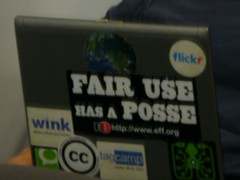

Photo courtesy Steve Rhodes under a (CC) license.

The court disagreed with the defendants’ contention that use of copyrighted works in legal proceedings is “inherently” a fair use. Citing to the case of Images Audio Visual Productions v. Perini Bldg. Co., 91 F.Supp.2d 1075 (E.D.Mich.2000), it observed that where judicial proceedings are one of the intended markets of the copyrighted work, the copyright holder is entitled to exercise control over the use of his works within this market; the fair use doctrine does not require the wholesale abandonment of copyright protection at the courthouse door.

But at least two other cases have held that use of copyrighted works in court proceedings is protected by fair use. In Religious Technology Center v. Wollersheim, 971 F.2d 364, 367 (9th Cir. 1992) the court found fair use where the defendants copied and distributed religious scriptures from former members of the Scientology Church and gave them to expert witnesses for the purpose of preparing testimony in the case. In Jartech v. Clancy, 666 F.2d 403, 406-07 (9th Cir.1982), abbreviated copies of adult movies for use as evidence in a nuisance abatement proceeding were considered fair use.

In this case, the court examined the four factors of 17 U.S.C. 107 to conclude that the use made by the defendants in attaching the web pages to the motion was a non-infringing fair use.

First, there were no allegations in the complaint that the defendants used the material for the “intrinsic purpose for which it was prepared,” namely, to “generate income” or provide “creative analysis and commentary about events occurring related to the [previous] lawsuit.”

The second factor also weighed in favor of fair use, as the materials were primarily a chronology of events, and thus were more factual in nature than creative.

As for the third factor, the court observed that the use of the work was limited. Accordingly, the factor carried “very little weight.” In any event, citing to Sega Enterprises Ltd. v. Accolade, Inc., 977 F.2d 1510, 1526 (9th Cir. 1992), the court hled that “the fact that an entire work was copied does not . . . preclude a finding of fair use.” (The case of Kelly v. Arriba Soft Corp., 336 F.3d 811 (9th Cir. 2003) would also have been a good case to cite for this point.)

Finally, for the important fourth factor — the effect on the market of the copyrighted work — the court found that the complaint did not allege that the marketability of the work was impaired. Moreover, the court observed that “[i]ndeed, it is impossible to imagine how the defendants’ use of the materials as an exhibit to a motion for attorneys’ fees could in any way impact the marketability of the materials.”

Shell v. Devries, (Slip Op.) No. 06-318, 2007 WL 324592 (D.Colo. Jan. 31, 2007)

del.icio.us users: I’d like your help

del_tube.jpg

On February 23, I’m speaking at a seminar hosted by the John Marshall Law School here in Chicago on the topic of copyright law and online video sharing sites (like YouTube). [More info on this seminar]

There is a lot going on with these kinds of sites lately, and it’s hard to keep up with all the developments. But I’d like to give a presentation that is up-to-date and thorough. And I’m asking for your help with that.

If you’re a del.icio.us user, from now until February 23, if you come across any interesting news story or blog post about YouTube, Revver, Grouper, Veoh, or any other video sharing site, would you kindly tag it with “icyoutube“? (The ic stands for Internet Cases.)

And by the way, if don’t use del.icio.us, why on earth not? For more information, read this classic exposition on the virtues of the king of all social bookmarking sites.

This collaboration thing could be pretty useful. Thanks for your help.

Great video about Web 2.0

If you’ve been reading this weblog for any time at all, you’ll know that it’s unusual for me to depart too far from topics dealing purely with the law. But the soul of “Internet law,” at least for now, is comprised in large part of the principles underlying Web 2.0. With that notion comes the challenge of how to deal with an Internet that is increasingly collaborative. Denise Howell directed me to the video embedded below, which was created by Michael Wesch, an obviously insightful professor of anthropology at Kansas State University. It’s an entertaining little video that explores the technological underpinnings of the modern Internet and leaves us with some poignant questions about how as a civilized society we need to deal with issues like copyright, governance, privacy, family, and ourselves.

[If you’re viewing this post in an RSS reader and the video doesn’t show up, click through so that you can see it.]

New Jersey gives nod to right of “informational privacy”

In contrast to federal right, state recognizes legitimate privacy interest in data held by third parties.

A New Jersey business owner began to suspect that one of his employees had, without authorization, accessed the company’s computer system to modify shipping and other customer information. The business owner knew someone with a Comcast IP address had accessed the system, and a police detective went to the local municipal court, to have the administrator issue a subpoena to Comcast. The ISP complied, and the information provided implicated the suspected employee. She was arrested, and before trial, successfully moved to suppress the evidence linking her identity with the IP address. The state sought review of the suppression of the evidence, and the appellate court affirmed. Pro-privacy advocates should applaud the court’s opinion.

The appellate court first looked at the validity of the subpoena that the administrator of the municipal court issued. For a number of reasons particular to New Jersey criminal procedure, the subpoena was invalid. (For example, the offense being investigated was one that would have been outside that court’s subject matter jurisdiction.)

The court then examined whether the invalidity of the subpoena really mattered. The lower court judge’s decision to suppress the evidence “might still be subject to reversal if [the] defendant had no privacy interest in the information obtained from Comcast. If there were no constitutionally protected privacy interest, it would not matter how the police obtained the information.”

Making no effort to conceal the fact that its decision departed from “uniform” federal jurisprudence on the issue, the court ruled in favor of the defendant’s “informational privacy.” Even though the U.S. Supreme Court “consistently has held that a person has no legitimate expectation of privacy in information he voluntarily turns over to third parties,” the New Jersey court continued a trend apparent in a number of past New Jersey cases which provide an individual with the right to control “the acquisition or release of information about oneself.” In New Jersey, this right to informational privacy is derived from an implied right of privacy found in the state’s constitution, and has manifested itself in past decisions involving a right to privacy in telephone records, bank records, and garbage left out for pickup.

Because the defendant had a reasonable expectation of privacy in her identity linked to the Comcast IP address, the state was required to get a valid subpoena before obtaining that information. Without the valid subpoena, the defendant’s rights were violated, and the evidence was properly excluded.

So does this mean that Internet subscriber information held by ISPs in New Jersey can never be revealed to law enforcement? No. But the court instructed “that information concerning the identity of an internet user can only be obtained by law enforcement through some means of judicial process.” All it takes is a valid subpoena.

State v. Reid, — A.2d —-, 2007 WL 135685 (N.J.Super.A.D., Jan. 22, 2007)

Scroll to top