Blog

Plaintiff has to turn over emotional social media content in employment lawsuit

Court holds that Facebook, LinkedIn and MySpace postings relating to plaintiff’s emotional state must be produced in discovery.

Robinson v. Jones Lang LaSalle Americas, Inc., 2012 WL 3763545 (D.Or. August 29, 2012)

Plaintiff sued her former employer for discrimination and emotional distress. In discovery, defendant employer sought from plaintiff all of her social media content that revealed her “emotion, feeling, or mental state,” or related to “events that could be reasonably expected to produce a significant emotion, feeling, or mental state.”
emotional on social media

When plaintiff did not turn over the requested content, defendant filed a motion to compel. The court granted the motion.

The court relied heavily on the case of E.E.O.C. v. Simply Storage Mgmt., LLC, 270 F.R.D. 430 (S.D.Ind. 2010) in ordering plaintiff to produce the requested social media content. The Simply Storage court found that:

It is reasonable to expect severe emotional or mental injury to manifest itself in some [social media] content, and an examination of that content might reveal whether onset occurred, when, and the degree of distress. Further, information that evidences other stressors that could have produced the alleged emotional distress is also relevant.

Consistent with the principles of Simply Storage the court in this case ordered production from plaintiff all social media communications:

that reveal, refer, or relate to any significant emotion, feeling, or mental state allegedly caused by defendant’s conduct;

The production of this category of communications was meant to elicit information establishing the onset, intensity, and cause of emotional distress allegedly suffered by plaintiff because of defendant during the relevant time period.

The court also ordered plaintif to produce all social media materials concerning:

events or communications that could reasonably be expected to produce a significant emotion, feeling, or mental state allegedly caused by defendant’s conduct.

This second category was meant to elicit information establishing the absence of plaintiff’s alleged emotional distress where it reasonably should have been evident (i.e., under the rubric of Simply Storage, on her social media accounts).

The court observed how counsel for the parties plays an important role in the discovery of social media. As the court in Simply Storage recognized, it is an “impossible” job for the court to define the limits of social media discovery with enough precision to satisfy the producing party. To address this impossible situation, it falls to the lawyers to act in good faith to produce required materials, inquire about what has and has not been produced, make the appropriate challenges, and seek revision of the discovery order as appropriate.

Photo courtesy Flickr user xdxd_vs_xdxd under this Creative Commons license.

Court allows service of complaint and summons via Yahoo email account

U.S. Commodity Futures Trading Com’n v. Rubio, 2012 WL 3614360 (S.D.Fla., August 21, 2012)

The government filed a civil suit against defendant for violation of the federal Commodity Exchange Act and related regulations. Try as it may, the government could not successfully serve the complaint and summons by traditional means. So the government asked the court for leave to file the papers via defendant’s Yahoo email account. The court granted the motion.

email at the beach

During an earlier state investigation, defendand had provided a Yahoo email address while testifying under oath. The government claimed that it had sent several messages to the same account, each time getting a confirmation receipt indicating the message had been read on a Blackberry using the Digicel network. The evidence in the record showed that Digicel is a provider of network services in the Caribbean, Central and South America.

Federal Rule of Civil Procedure Rule 4(f)(3) authorizes a court to order an alternate method for service to be effected upon defendants located outside the United States, provided that such service (1) is not prohibited by international agreement and (2) is reasonably calculated to give notice to the defendant consistent with its constitutional due process rights.

In evaluating whether email service in this case would run afoul of international law, the court found that the Hague Convention did not apply because defendant’s precise location was not known — the only information in the record was that he was in the Caribbean, Central or South America. The Inter-American Convention on Letters Rogatory did not prohibit email service in this case, as that Convention would not necessarily preclude service by means outside the scope of its terms.

The court found that email service was also reasonably calculated to give notice to defendant, based on the facts in the record. Here, the government showed that the still-active Yahoo email address about which defendant swore under oath was reasonably calculated to give notice of the action against him and an opportunity to respond.

See also:

Federal court permits service of process on Australian defendants by e-mail

Service of process by e-mail allowed for foreign defendants

Court rejects request for permission to serve process by e-mail

Photo credit: Flickr user Giorgio Montersino under this Creative Commons license.

The day I met Neil Armstrong

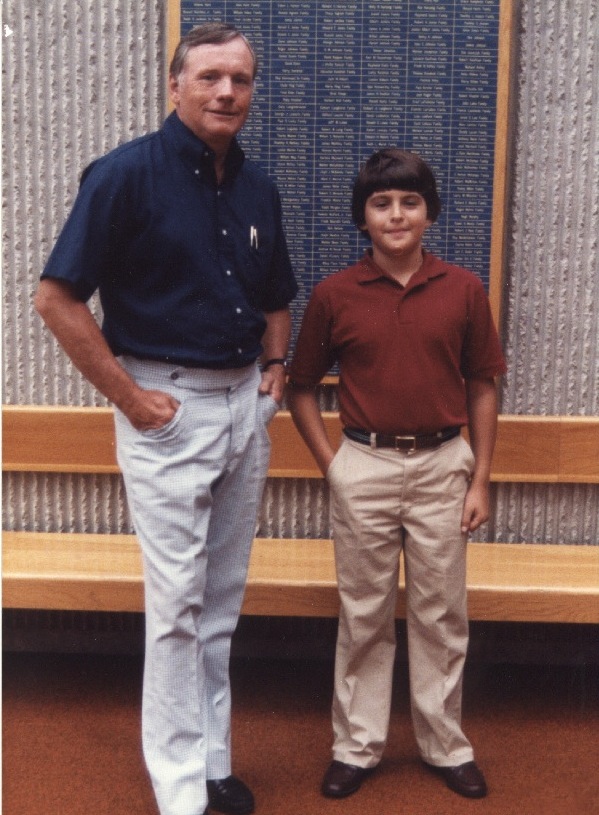
I spent an afternoon with Neil Armstrong in July 1985, when I was 10 years old. He was my childhood hero. The day I met him was, up to that point, the biggest day of my life. So it has been particularly poignant for me to learn of his death earlier today.

Back then I was really into — or should I say, obsessed with — space flight and astronomy. And I had some nerd cred. My parents gave me an awesome telescope and I was among the first in my community to spot Halley’s Comet when it came around. I went to Space Camp the summer after Challenger exploded. I built and launched model rockets. I read every book about astronomy in our local library. Inspired by Gus Grissom and by Charlie Walker, NASA astronauts who hailed from my county in Indiana, I was set on being an astrophysicist and traveling into space one day. That determination was what made me resilient (or maybe just oblivious) to the jeers I got when I wore my blue NASA flight suit to school one day in fifth grade.

My parents’ good friend Ned Boyer was a fraternity brother of Neil Armstrong’s at the Phi Delt house at Purdue back in the 50’s. Ned and Neil had stayed in touch over the years, and when Ned saw how much I loved space flight and astronomy, and how I idolized the NASA astronauts, he arranged for our families to travel to Lebanon, Ohio to meet Neil.

We met Neil and his then-wife Janet at the historic Golden Lamb restaurant in Lebanon. We sat at a long table for lunch, with Neil at one head of the table, and me at the corner of the table, at his right hand. I asked him the battery of simple-minded questions that a 10 year old geeky kid would ask, like how he would describe the dust on the moon as his boot sank in. I remember also asking him about his and David Scott’s emergency undocking from the Agena during Gemini 8 — a topic on which I imagine he was interrogated less frequently than Apollo 11. In the years since meeting him, I’ve often reflected on what questions I would ask him from a mature perspective, like how does one deal with the profundity of the singular accomplishment of being the only human in the history of the world to ever have the distinction of being the first to step foot on a celestial body other than the Earth.

After lunch we decided to go see the local YMCA which at that time was either new or newly-renovated. I’m not sure of the details, but I know Neil was involved in that project somehow. Here’s the awesome part of that — I rode in the back seat of his beige station wagon while he drove us there. I remember thinking to myself how incredible it was that I was being transported at that moment by the Commander of the Eagle — the very person who uttered those eternal words, “that’s one small step for [a] man, one giant leap for mankind.” We hung out there at the YMCA for awhile longer. That’s where the picture of him and me you see above was taken.

Neil’s family issued a statement earlier today requesting that we should “honor his example of service, accomplishment and modesty.” To say he was modest is an understatement. Though he was one of the most famous people in the world — and indeed one of the most important people in all of history — he never sought to capitalize on his celebrity.

Today we lost one of the most important historical figures of our age. I put Neil Armstrong’s significance in the same category as that of Christopher Columbus. Until today we were all contemporaries of the man who accomplished one of the most meaningful things ever. Now he precedes us. Godspeed, Neil!

Facebook caused wife to stab her husband

U.S. v. Mask, 2012 WL 3562034 (N.M.Ct.Crim.App., August 14, 2012)

No doubt Facebook use can be an enemy to marriage — see, for example, this recent article about how Facebook was named in a third of divorce filings in 2011. A recent case from the military courts shows how using Facebook can put a spouse’s very life in peril.

She is yelling and is very angry.

Defendant wife became angry when she accessed her husband’s Facebook account. An argument ensued between defendant and her husband about the content of husband’s Facebook page, which escalated and turned violent. The two struggled, with defendant yanking the modem out of the wall and striking husband. She continued to hit him, causing him to back into the kitchen, where defendant grabbed a knife and stabbed husband in the abdomen, saying, “that’s what you get, mother fucker.”

Husband survived, and wife was tried and convicted of attempted manslaughter. She sought review with the Navy–Marine Corps Court of Criminal Appeals. On appeal the court affirmed the conviction and five year sentence. It held the evidence at trial was sufficient to support the verdict, and that defendant’s Fifth Amendment rights had not been violated.

Photo courtesy Flickr user normalityrelief under this Creative Commons license.

No Fourth Amendment violation when government looked at Facebook profile using friend’s account

U.S. v. Meregildon, — F.Supp.2d —, 2012 WL 3264501 (S.D.N.Y. August 10, 2012)

The government suspected defendant was involved in illegal gang activity and secured the assistance of a cooperating witness who was a Facebook friend of defendant. Viewing defendant’s profile using the friend’s account, the government gathered evidence of probable cause (discussion of past violence, threats, and gang loyalty maintenance) which it used to swear out a search warrant.

What you do on Facebook is almost guaranteed to come back and bite you in the ass.

Defendant argued that the means by which the government obtained the probable cause evidence – by viewing content protected by defendant’s Facebook privacy settings – violated defendant’s Fourth Amendment rights. The court denied defendant’s motion to suppress.

It held that where Facebook privacy settings allowed viewership of postings by friends, the Government could access them through a friend/cooperating witness without violating the Fourth Amendment. The court compared the scenario to how a person loses his legitimate expectation of privacy when the government records a phone call with the consent of a cooperating witness who participates in the call. It held that defendant’s legitimate expectation of privacy ended when he disseminated posts to his Facebook friends because those friends were then free to use the information however they wanted, including sharing it with the government.

Photo credit: Flickr user Poster Boy NYC under this Creative Commons license.

Did a Facebook breakup cause a murder?

According to this news report, a man in Martinsville, Indiana allegedly shot the mother of his 14-month-old daughter after the woman broke up with him through Facebook. Though one should not jump to concluding that Facebook caused this murder, we are left to consider whether the nature of social media communications contributed to the alleged killer’s motivation.

public breakup

Breaking up is supposed to be a private event. Though we do not know the precise means the woman used to communicate the breakup (was it a private message or an IM, or was it more public like a status update or wall post?), one cannot help but notice the incongruity of using a social media platform to communicate a sensitive matter. Equally intriguing as the breakup is the man’s alleged apology in advance that he posted to Facebook before the murder.

Social media, just like any technology, gives us choices. Stories like this show how, in certain circumstances, human nature may not always be up to the task of making the right decisions when that process is affected by a novel context like the seemingly public context of Facebook.

Photo courtesy Flickr user Unlisted Sightings under this license.

Reading a non-friend’s comment on Facebook wall was not a privacy invasion

Sumien v. CareFlite, 2012 WL 2579525 (Tex.App. July 5, 2012)

Plaintiff, an emergency medical technician, got fired after he commented on his coworker’s Facebook status update. The coworker had complained in her post about belligerent patients and the use of restraints. Here is plaintiff’s comment:

Yeah like a boot to the head…. Seriously yeah restraints and actual HELP from [the police] instead of the norm.

After getting fired, plaintiff sued his former employer for, among other things, “intrusion upon seclusion” under Texas law. That tort requires a plaintiff to show (1) an intentional intrusion, physical or otherwise, upon another’s solitude, seclusion or private affairs that (2) would be highly offensive to a reasonable person.

The trial court threw out the case on summary judgment. Plaintiff sought review with the Court of Appeals of Texas. On appeal, the court affirmed the summary judgment award.

The court found plaintiff failed to provide any evidence his former employer “intruded” when it encountered the offending comment. Plaintiff had presented evidence that he misunderstood his co-worker’s Facebook settings, did not know who had access to his co-worker’s Facebook Wall, and did not know how his employer was able to view the comment. But none of these misunderstandings of the plaintiff transformed the former employer’s viewing of the comment into an intentional tort.

Read Professor Goldman’s post on this case.


Photo credit: Flickr user H.L.I.T. under this license.

DMCA takedown notices are not just for content

Apple using the DMCA to stop early sales of iOS 6.

The infamous Digital Millennium Copyright Act takedown process gets quite a bit of press when content owners such as movie studios and record companies use it to take infringing copies of films or music offline. The safe harbor provisions of the DMCA are at the heart of content-distribution platforms’ defenses against infringement occasioned by users of the platform. (Think Viacom v. YouTube.)

Apple reminds us, however, that the DMCA gives all copyright owners — not just those who own copyrights in content — a mechanism for getting infringing works off the internet. According to this piece on Engadget, Apple has been contacting hosting providers of sites that offer unauthorized copies of the forthcoming iOS 6 for sale.

So the DMCA, acting in the name of copyright protection, provides a remedy for software providers to keep the clamps on parties who may have access to software for their own use (in this case, iOS developers) but go outside the bounds of such use and offer the technology for sale to others.

Can you snoop if someone has forgotten to log out?

About the Author: Evan Brown is a Chicago technology and intellectual property attorney. Need assistance? Call Evan at (630) 362-7237, send email to ebrown [at] internetcases.com, or follow him on Twitter @internetcases.

Marcus v. Rogers, 2012 WL 2428046 (N.J.Super.A.D. June 28, 2012)

The answer to that question may depend on whether you knowingly exceed your authorization. A New Jersey court recently held that a defendant was within the bounds of the law when he accessed and printed a co-worker’s personal email after the coworker left the computer without signing out of her account.

can you snoop the email account left on the screen when someone forgets to log out

One morning when defendant, a teacher, sat down in the computer room of the school where he worked to check his email, he bumped the mouse of the computer next to him when he sat his drink down. That stopped the screen saver on the other machine, revealing the inbox of a coworker’s Yahoo account. Defendant saw that some of the emails’ subjects mentioned him, so he clicked on them, printed them out, and later used them at an adminstrative meeting to further some points in a work dispute.

The coworkers whose email communications defendant had accessed in this way sued him for violation of New Jersey’s equivalent of the Stored Communications Act (N.J.S.A. 2A:156A–27). The plaintiffs moved for summary judgment on their claim, but the court let the question go to the jury. That jury found defendant had not violated the statute.

Plaintiffs appealed the denial of their motion for summary judgment. On appeal, the court affirmed, holding that the jury properly got the question to consider.

Under the New Jersey statute, a plaintiff has a cause of action if, among other things, another person knowingly:

  • accesses without authorization a facility through which an electronic communication service is provided, or
  • exceeds an authorization to access that facility

The court briefly discussed whether the term knowingly applies both to “access without authorization” and “exceeds an authorization”. It held that it does.

Then the court went on to evaluate whether the jury should have gotten the question in the first place.

The court held that as a matter of law, defendant did not access the email account without authorization. Because the “index to the inbox” of the co-worker’s Yahoo account was displayed on the screen when the coworker left the computer, defendant did not access the “facility” without authorization. The accessing of the facility had been accomplished by coworker. There was no evidence of hacking or other unauthorized access to her account.

As for whether defendent exceeded his authorized access, the court held that the lower court properly submitted the question to the jury. The court held that the facts could not preclude a jury finding that defendant did not exceed his authorized access. Indeed, six of the seven deliberating jurors found that defendant had not exceeded his authorization. And all of the jurors found that the coworker had provided “tacit authorization” for him to access the account. (The case does not specify what that evidence of tacit authorization was.)

So the jury’s finding that defendant did not exceed his authorized access stood.

An obvious pro-tip from the case is to remember to log out of shared computers. But the decision is potentially relevant to contexts other than email accounts on desktop computers. Does a person who finds another’s mobile device have the right to rummage through all the accounts (e.g., social media, email, dating sites) that the phone’s owner is logged into? This case underscores that the answer will be, frustratingly, “it depends.” It’s best to put some facts into play — like even the simple requirement of a 4-digit password — to establish contours for authorization which, when exceeded, are clear.

Social media angle on SCOTUS healthcare decision

I’ve seen three interesting social media issues arise in the hours following the Supreme Court’s decision this morning on Obamacare:

1. Premature enunciation and the ensuing bruhaha

In a rush to report on the extremely complex decision, CNN’s website briefly stated that the healthcare law had been overturned. [Screenshot] Folks on Twitter were quick to pounce, and it still seems to be kind of flying under the radar that FOX News’ side-scrolling ticker got it wrong too. The comparisons to Dewey Defeats Truman are obvious. The picture below by @garyhe captures this notion visually.

But there are a couple important differences in modern and social media versus the 1940s.

Because of the faster means to get the word out, there is even more pressure for a media outlet to be the first. (The same kind of pressure, felt by a humble blogger like me to be among the first to analyze the issues herein is making it difficult for me to type right.) And members of mainstream media are not just competing against other mainstream media participants. As @roncoleman tweeted, “[t]he central role of @SCOTUSblog in this discussion is the truly historical event occurring today.” (@SCOTUSblog’s coverage of the decision was driven largely by the work of 81-year-old Lyle Denniston.)

And it’s easy to forget that mistakes in reporting can easily be undone. Unlike the paper in the Dewey Defeats Truman situation, which had to literally stop the presses, reset the type, print out new stacks of papers and physically deliver them hours later, the CNN website was changed immediately with little human effort. And the fact that CNN got it wrong couldn’t have harmed anyone, given that there were millions of commentators on Twitter to instantly lampoon it, thereby drawing attention to the error.

2. It’s not just law professors who can be constitutional scholars

@jonathanwpeters observed the profundity of how the discourse on Twitter had become erudite by simply noting: “June 28, 2012: the day that “Commerce Clause” trended on Twitter.” But maybe that eruditeness is just a facade. @jbtaylor gives us a warning: “Brace yourself. Everyone on Twitter is about to become a Constitutional scholar.”

3. Everyone’s a comedian and all the world’s a comedy club

Probably the best part of the social media response to the decision is the humor. Here are a few of my favorite tweets that look at the farcical side of this:

  • “Remember when John Roberts botched the President’s swearing-in on Inauguration Day? I think they’re all good now.” (by @johnsberman)
  • “I felt a sudden disturbance in the Law, as if millions of nascent law review articles cried out, and were suddenly silenced.” (by @timhwang)
  • “Tea Party just turned into a massive kegger as the last spare change has gone to buy all the beer left in St. Louis ‪#wow‬ (by @mimizhusband)
  • “Now that that’s over who wants to grab a Coke and watch some porn” – Clarence Thomas (by @platypusjones)
Scroll to top